Mobile Apps in Property Marketing: A 2026 Agent Guide
Mobile Apps in Property Marketing: A 2026 Agent Guide

TL;DR:
- Mobile apps are essential for real estate professionals to connect with buyers, build brand loyalty, and convert leads.
- They outperform websites and email by providing personalized, fast responses that match buyer behavior and preferences.
Mobile apps are the primary channel through which real estate professionals connect with buyers, qualify leads, and close deals faster than any desktop or email-based approach. The role of mobile apps in property marketing has shifted from optional add-on to core infrastructure. 97% of home buyers use the internet to search for property, and 71% find listings through mobile devices. That means the buyer’s first impression of your brand almost certainly happens on a phone screen. Agents who treat mobile as a secondary channel are already behind.
How mobile apps shape agent branding and client engagement
A branded real estate mobile app functions as a persistent marketing asset that keeps your name and listings in front of buyers throughout their search. The average buyer spends 4.7 months searching before contacting an agent. That is 4.7 months during which a generic portal app shows your competitor’s listings right next to yours. A branded app removes that noise entirely.
AI-driven backends inside modern real estate apps automatically surface personalized listing recommendations based on each buyer’s search behavior. That personalization builds trust faster than any email drip campaign. Buyers feel understood rather than marketed to, and that distinction drives engagement.
Apps also serve as central communication hubs for real estate teams. Agents can respond to inquiries, share documents, and schedule showings without switching between five different tools. Faster response times directly correlate with higher lead quality, because buyers who get answers quickly are far less likely to contact a competing agent.
- Branded home screen presence: Your app icon on a buyer’s phone is a daily brand impression that costs nothing after installation.
- AI-personalized listings: Automated recommendation engines surface relevant properties without manual curation.
- Unified communication: In-app messaging, document sharing, and scheduling reduce friction for both agents and buyers.
- Trust through speed: Faster replies signal professionalism and keep buyers engaged with your pipeline.
Pro Tip: Set up automated push notifications for new listings that match a buyer’s saved search criteria. That single feature alone keeps buyers returning to your app daily rather than drifting to a generic portal.
What features actually drive property sales through mobile apps?
The features that convert leads in real estate apps are not the flashiest ones. They are the ones that reduce friction at every decision point. 65% of real estate professionals report that push notifications, real-time messaging, and instant alerts improve client connection speed and lead quality. That outperforms both email and static websites by a significant margin.
Here are the four feature categories that deliver the clearest return:
- Instant action buttons. Click-to-call, in-app chat, and schedule-a-showing buttons eliminate the steps that cause buyers to abandon a listing. Fewer steps mean more conversions.
- Push notifications. Smart, behavior-triggered alerts for price drops, new listings, or open house reminders keep buyers engaged without requiring them to open the app manually.
- CRM integration. Apps connected to a CRM system show lead conversion improvements of about 41% because every buyer interaction feeds directly into a segmented follow-up workflow.
- Rich media and virtual tours. High-quality photo galleries and virtual walkthroughs reduce the number of in-person visits needed before a buyer commits, which compresses the sales cycle.
Behavioral tracking inside the app adds another layer. When you can see that a buyer has viewed the same listing seven times, you know exactly when and how to follow up. That kind of data-driven segmentation is what separates agents who close at high rates from those who rely on gut instinct.
| Feature | Primary benefit | Impact on conversion |
|---|---|---|
| Push notifications | Re-engages passive buyers | High |
| CRM integration | Automates follow-up workflows | Very high |
| In-app chat | Reduces response lag | High |
| Virtual tours | Reduces unnecessary showings | Medium to high |
| Behavioral tracking | Enables precise segmentation | Very high |
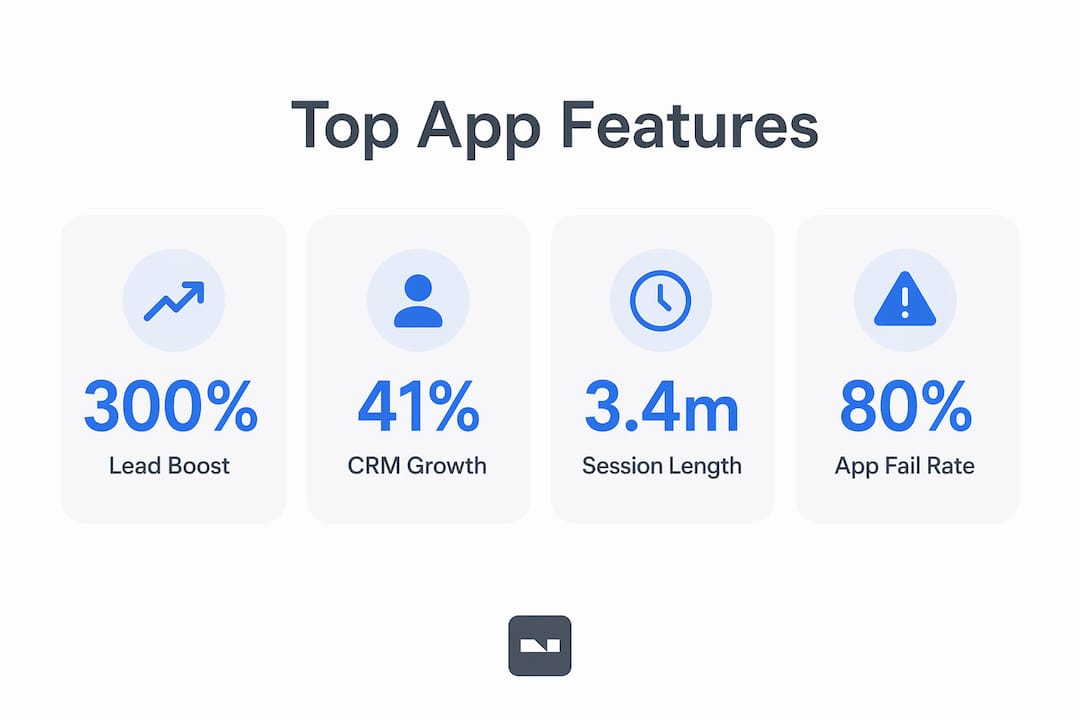
Some platforms report up to 300% higher lead conversions when smart push notifications and CRM integration work together. That number reflects what happens when communication and data systems stop operating in silos.
Why does mobile-first design matter for property apps?
Mobile-first design is not about making a website fit a smaller screen. It is about building for a completely different user mindset. Mobile sessions average 3.4 minutes, focused on quick, specific tasks like checking a photo or confirming a showing time. Desktop sessions average 18.7 minutes and involve deeper work like reviewing contracts or comparing neighborhoods. These are two distinct behaviors that require two distinct design approaches.

Agents who treat mobile as simply a smaller desktop site pay a real cost. Platforms that rely on responsive desktop designs rather than mobile-first architecture show 23% lower mobile engagement. Lower engagement means fewer return visits, fewer saved searches, and fewer leads captured.
| Session type | Average duration | Primary user task |
|---|---|---|
| Mobile app | 3.4 minutes | Quick photo views, alerts, scheduling |
| Desktop browser | 18.7 minutes | Deep research, contract review, comparisons |
The practical implication is clear. Mobile interfaces need large photos that load fast, one-tap contact buttons, and notification systems that pull buyers back into the app. Desktop interfaces can afford more information density. Designing one layout to serve both behaviors produces a mediocre experience on both platforms.
Pro Tip: Test your app’s core actions, viewing a photo, sending a message, and booking a showing, with one hand on a phone. If any step requires two hands or more than two taps, redesign it. That three-step rule catches most mobile UX failures before launch.
Vibemyflat’s approach to mobile design visualization reflects this principle directly. Property photos edited and optimized for mobile viewing perform better in app environments because they load quickly and display correctly on any screen size.
What causes real estate apps to fail after launch?
80% of real estate mobile apps fail within the first year, and the cause is almost never the technology. Poor post-launch marketing and user engagement are the primary culprits. A well-built app with no growth plan is just an expensive brochure.
The failure pattern is predictable. Day 1 churn rates reach 77%, meaning most users who download an app never return after the first session. Agents who do not plan for this lose their entire acquisition investment in 24 hours.
Successful real estate apps share a specific growth profile: targeting 10,000 monthly active users with 15% month-over-month growth in the first quarter. That benchmark is not arbitrary. It reflects the minimum engagement level needed to generate enough behavioral data for AI personalization to work effectively.
- Pre-launch marketing infrastructure: Build your email list, social audience, and referral network before the app goes live. Platforms that deploy marketing capabilities pre-launch reach ROI 2.7 times faster than those adding marketing post-launch.
- Onboarding sequences: The first three sessions determine whether a user becomes a regular. Guide new users to save a search, enable notifications, and contact an agent within those sessions.
- Retention campaigns: Weekly push notifications, personalized market updates, and re-engagement emails keep monthly active user counts from eroding.
- Technology choice is secondary: Native apps and progressive web apps perform equally well when properly supported. Marketing infrastructure matters far more than the tech stack.
Preparing a property for its app debut also matters. Physical presentation affects digital engagement. Resources like odor-free home staging remind agents that mobile marketing success depends on the quality of what you are marketing, not just how you distribute it.
Key Takeaways
Mobile apps are the most direct, data-rich channel available to real estate professionals for reaching buyers, building brand loyalty, and converting leads throughout a 4.7-month buying journey.
| Point | Details |
|---|---|
| Mobile dominates property search | 71% of buyers find listings on mobile devices, making app presence non-negotiable. |
| CRM integration drives conversions | Apps connected to CRM systems show roughly 41% higher lead conversion rates. |
| Mobile-first design outperforms responsive | Mobile-first platforms generate 23% higher engagement than responsive desktop adaptations. |
| Post-launch marketing determines survival | 80% of real estate apps fail within a year due to weak engagement strategies, not poor development. |
| Pre-launch infrastructure pays off | Deploying marketing capabilities before launch accelerates ROI by 2.7 times. |
The uncomfortable truth about real estate app strategy
Real estate professionals spend months debating which app features to build and almost no time planning how to keep users engaged after download. I have seen this pattern repeatedly. Agents invest heavily in virtual tours, AI chat, and polished design, then watch their daily active user count collapse within 30 days because nobody built a retention workflow.
The agents who win with mobile apps treat them the way media companies treat publications. They publish consistently, they segment their audience, and they measure engagement weekly. A listing alert is not just a notification. It is an editorial decision about what to surface, when, and to whom.
The other underrated factor is visual quality. Buyers form opinions about a listing in under two seconds on a phone screen. An app full of dark, poorly framed photos loses buyers before they read a single spec. Tools like Vibemyflat’s AI-powered photo editing exist precisely to close that gap. Agents who invest in photo quality see longer session times and more saved listings, both of which feed the behavioral data that makes personalization work.
The agents who treat mobile apps as a technology project rather than a marketing channel are the ones who end up in the 80% failure group. The ones who treat it as an ongoing audience-building effort are the ones who compound their advantage every month.
— Hello
Vibemyflat and your mobile property marketing strategy
Real estate professionals who want their mobile marketing to convert need more than a well-built app. They need listings that perform visually from the first screen tap.
Vibemyflat gives agents and property marketers the ability to edit and enhance listing photos in under 30 seconds using AI. Describe the change you want in plain language, and Vibemyflat delivers a professional result ready for your app, your portal listings, and your social channels. The platform works on iOS, Android, and desktop, so your team can update visuals wherever the work happens. Agents who prioritize listing photo quality see measurable gains in mobile engagement and lead capture. Start with Vibemyflat at vibemyflat.com and see the difference in your next listing.
FAQ
What is the role of mobile apps in property marketing?
Mobile apps in property marketing serve as direct, branded channels that connect agents with buyers through personalized listings, push notifications, and in-app communication. They outperform email and static websites in lead engagement and conversion speed.
How do mobile apps improve lead conversion for real estate agents?
Apps integrated with CRM systems improve lead conversion rates by about 41% through behavioral tracking and automated, personalized follow-up workflows. Smart push notifications can push that figure even higher.
Why do most real estate mobile apps fail?
80% of real estate apps fail within the first year because of poor post-launch marketing and engagement strategies, not technical problems. Day 1 churn rates reach 77%, making onboarding and retention planning critical from day one.
How does mobile-first design affect property app performance?
Mobile-first design produces 23% higher engagement than responsive desktop adaptations because it matches the 3.4-minute, task-focused behavior of mobile users rather than forcing a desktop experience onto a smaller screen.
How many buyers use mobile devices to search for property?
71% of home buyers find listings through mobile devices, and 97% use the internet at some point in their property search. These figures make mobile app presence a baseline requirement for any serious real estate marketing strategy.