Photo editing for home staging: sell 32% faster
Photo editing for home staging: sell 32% faster
TL;DR:
- Proper photo editing significantly speeds up home sales and increases property prices.
- Key techniques include exposure adjustment, virtual staging, and color correction.
- Ethical editing enhances trust by accurately representing the property’s true appearance.
Professionally edited listing photos are no longer a nice-to-have. Homes with polished images sell 32% faster and command prices 1 to 10% higher than comparable properties with unedited shots. For real estate agents and property managers, that gap translates directly into commission, client satisfaction, and competitive edge. This guide breaks down exactly how photo editing supports home staging goals, which techniques move the needle most, and how to avoid the credibility traps that catch even experienced professionals off guard.
Table of Contents
- Why photo editing is essential for home staging
- Key photo editing techniques used in home staging
- Real impact: The business case for photo editing in home staging
- Common pitfalls and best practices
- The reality behind photo editing: What truly earns trust and results
- Take your staged listings to the next level with expert editing
- Frequently asked questions
Key Takeaways
| Point | Details |
|---|---|
| Dramatic sales impact | Professionally edited listing photos help homes sell much faster and for higher prices. |
| Technique variety counts | Multiple editing methods like brightness, decluttering, and virtual staging deliver the best visual appeal. |
| Cost-effective staging | Photo editing—especially virtual staging—offers dramatic savings versus traditional methods without sacrificing results. |
| Ethics and disclosure matter | Enhance images realistically and always disclose virtual staging to maintain trust with buyers. |
Why photo editing is essential for home staging
Home staging is about helping buyers picture themselves living in a space. But even the most beautifully arranged room can fall flat in photos if the lighting is off, the angle is awkward, or a stray cable draws the eye. Photo editing is the bridge between a well-staged room and a listing photo that actually converts.
The professional photo editing benefits for real estate go well beyond making things look pretty. Editing corrects exposure problems that cameras introduce, removes distracting objects that weren’t noticed during the shoot, and allows for virtual staging of empty or outdated spaces. According to industry research, photo editing enhances staging by fixing lighting, removing distractions, and enabling virtual furniture placement that transforms bare rooms into inviting spaces.
Here is what well-edited listing photos accomplish for your marketing:
- More online views: Listings with polished photos get significantly more clicks on major portals.
- Higher initial offers: Buyers perceive value through visuals before they ever walk through the door.
- Shorter time on market: Clean, bright, well-composed photos reduce the “what’s wrong with it” hesitation buyers feel.
- Broader buyer reach: Virtual staging lets you target multiple buyer demographics by swapping furniture styles digitally.
- Lower overall marketing costs: One great photo session, edited well, works across print, digital, and social media.
“The data is clear: edited photos sell homes 32% faster and for 1 to 10% more than unedited listing images.”
Think about the buyer experience. Most home searches start online. A buyer scrolling through 40 listings will spend about two seconds on each thumbnail before deciding to click or skip. That two-second window is won or lost on photo quality alone. Editing is not about deception. It is about presenting a property at its genuine best, the same way a seller would clean and tidy before an open house.
Property managers benefit just as much. A rental unit with bright, decluttered photos fills faster and attracts tenants who respect the space. The investment in editing pays back quickly through reduced vacancy time.
Key photo editing techniques used in home staging
Not all editing is created equal. Some techniques make a subtle but powerful difference, while others can backfire if overdone. Here is a breakdown of the methods that consistently deliver results.
| Technique | Primary benefit | Common pitfall |
|---|---|---|
| Exposure and brightness adjustment | Reveals detail in shadows and highlights | Blown-out windows or flat, washed-out tones |
| HDR blending | Balances interior and exterior light | Unnatural, over-processed look |
| Object removal and decluttering | Creates clean, distraction-free compositions | Leaving obvious editing artifacts |
| Color correction | Accurate wall and floor tones | Over-saturated or unrealistic hues |
| Perspective correction | Straight verticals and accurate proportions | Distorted room dimensions |
| Sky replacement | Dramatic, appealing exterior shots | Mismatched lighting between sky and building |
| Day-to-dusk conversion | Emotional, premium feel for exterior shots | Artificial-looking light sources |
| Virtual staging | Furnishes empty spaces digitally | Furniture scale errors or wrong style fit |
The key techniques that move listings fastest are exposure adjustments, HDR blending, decluttering, sky replacement, and virtual staging. Each one solves a specific visual problem buyers notice even if they cannot name it.
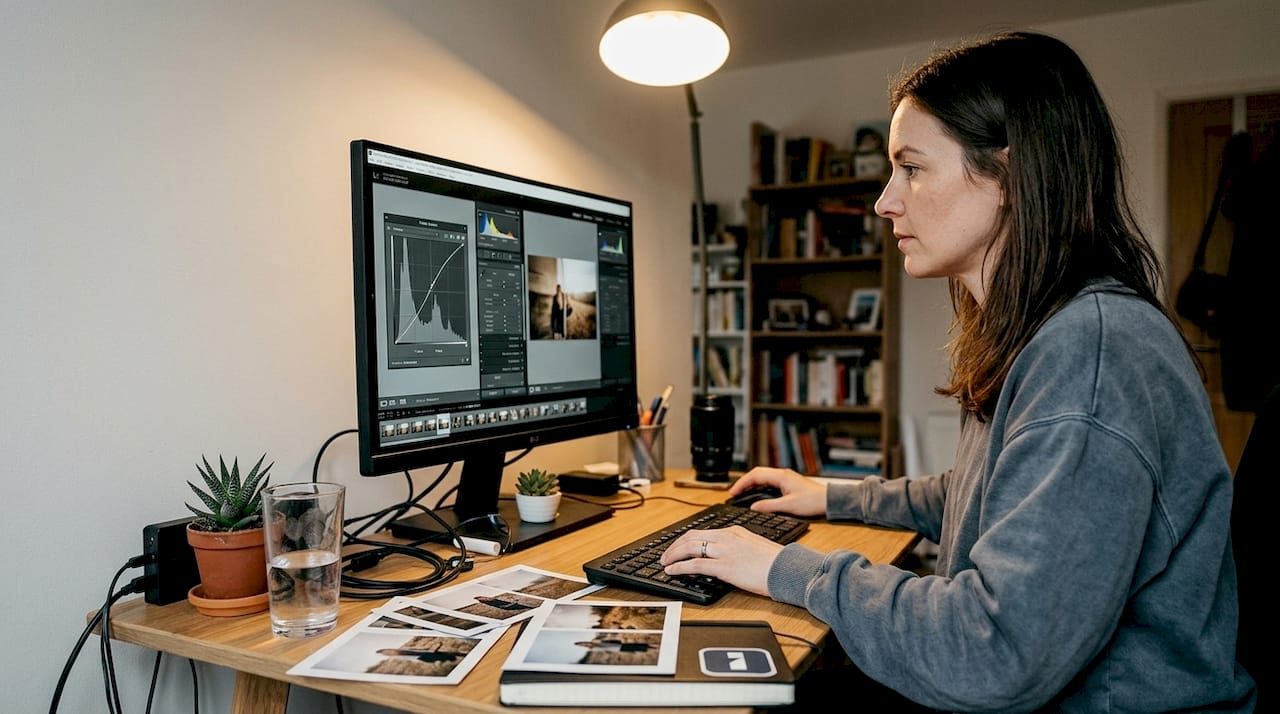
For agents working with older or vacant properties, virtual staging is a game changer. Instead of spending thousands on physical furniture rental, you can digitally furnish a space in hours. Buyers respond emotionally to furnished rooms because empty spaces are hard to mentally fill.
Color correction deserves more attention than it gets. A warm-toned living room photographed under cool fluorescent light looks institutional and cold. Correcting the white balance and color temperature restores the inviting atmosphere the room actually has. Check out this interior photo editing tutorial for a practical walkthrough, or explore a DIY design editing guide if you want to handle corrections yourself.
Pro Tip: Always shoot in RAW format rather than JPEG. RAW files retain far more data, giving editors much greater flexibility to recover shadows, correct color, and sharpen detail without introducing noise or artifacts.
Perspective correction is often overlooked. Wide-angle lenses, which most real estate photographers use, distort vertical lines so that walls appear to lean inward or outward. Straightening those lines makes rooms look larger, more polished, and architecturally accurate.
Real impact: The business case for photo editing in home staging
The numbers behind photo editing in real estate are hard to ignore. Virtual staging costs 97% less than physical staging, which typically runs $1,500 to $5,000 or more per property. A digitally staged listing can be ready in 24 to 48 hours instead of days of furniture logistics.
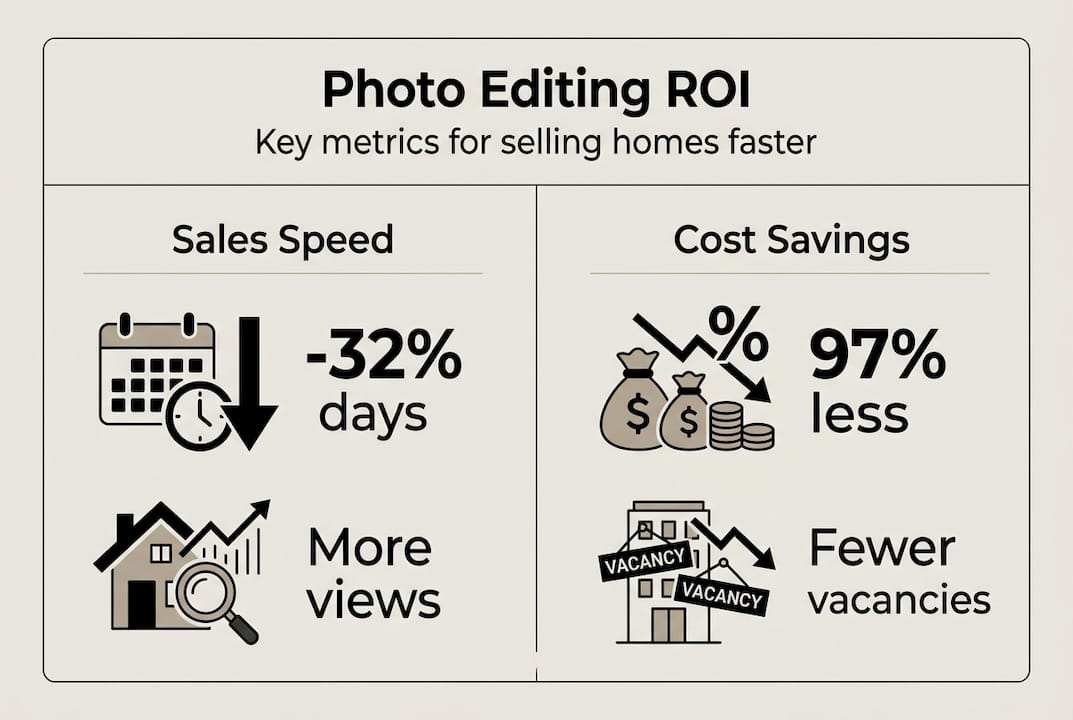
The fast photo editing benefits extend beyond cost. Speed matters in competitive markets where listings go live and go under contract within days.
Key business benefits of professional photo editing:
- Faster sales cycles: Edited listings spend less time on market, freeing agents to take on more clients.
- Higher offer prices: Better photos set a premium perception that buyers carry into negotiations.
- Reduced physical staging costs: Virtual staging eliminates furniture rental, delivery, and setup fees.
- Stronger personal brand: Consistently polished listings build a reputation that attracts more referrals.
- Better performance across platforms: High-quality images perform better in paid ads, social posts, and email campaigns.
| Metric | Edited listings | Unedited listings |
|---|---|---|
| Average days on market | Reduced by ~32% | Baseline |
| Offer price premium | 1 to 10% higher | Baseline |
| Online click-through rate | Significantly higher | Baseline |
| Virtual staging cost | $100 to $300 per room | $1,500 to $5,000 physical |
The emotional impact of certain edits is also measurable. Twilight edits gain 76% more views than standard daytime exterior shots. That single edit, converting a flat afternoon photo into a warm evening scene with glowing windows, can dramatically increase the number of showings requested. The same NAR data shows that 83% of agents report staging helps buyers visualize a property as their future home, and 17% report directly higher offers on staged listings.
For property managers, the ROI shows up in vacancy rates. A well-edited photo set for a rental unit can reduce vacancy by weeks, which at average urban rents adds up to hundreds or thousands of dollars per year per unit.
Common pitfalls and best practices
Photo editing is a powerful tool, but it cuts both ways. Overuse or misuse can damage your credibility and expose you to legal and ethical risk. Understanding where the line sits is just as important as knowing the techniques.
“Avoid misleading edits, disclose virtual staging per NAR and MLS guidelines, and be cautious of AI tools that blur the line between enhancement and fabrication.”
The ethical standard in real estate photo editing is straightforward: every edit should reflect something that is genuinely present or achievable. Brightening a dark room is fine. Digitally removing a power line that runs across the yard is a gray area. Replacing a cracked driveway with a perfect one is misleading. Buyers will see the property in person, and when reality does not match the photos, trust collapses fast.
Common pitfalls and how to fix them:
- Over-brightening dark rooms: Buyers notice when a room that looks sunny online is actually dim in person. Fix: Use realistic brightness levels that match natural light conditions.
- Exaggerating lawn quality: Don’t over-edit poor lawns or make small spaces look dramatically larger than they are. Fix: Enhance what exists, don’t fabricate.
- Skipping virtual staging disclosure: NAR and MLS rules require disclosure when photos include virtual furniture. Fix: Label virtually staged images clearly in the listing.
- Perspective distortion: Using extreme wide-angle corrections to make rooms appear bigger than they are. Fix: Keep corrections realistic and proportional.
- Inconsistent editing across a listing: One bright, polished photo followed by a dark, flat one signals amateur work. Fix: Apply consistent editing standards to every image in a set.
Pro Tip: For small spaces, use vertical correction to straighten walls and raise the perceived ceiling height. Avoid adding furniture that is too large for the actual room. Buyers who visit in person will immediately notice the disconnect, and that erodes trust in everything else you have presented.
The AI rapid editing tools available today make it easier than ever to edit quickly, but speed should never come at the cost of accuracy. Use user-friendly apartment editing workflows that include a final review step where you ask: would a buyer feel misled when they walk through the door?
The reality behind photo editing: What truly earns trust and results
Here is something most articles on this topic miss. The best photo editors in real estate are not the ones who make properties look the most spectacular. They are the ones who make properties look the most accurately appealing.
There is a subtle but important distinction. Every enhancement you make sets an expectation. When a buyer walks in and the space matches or exceeds what the photos showed, trust is built and deals close. When reality falls short, buyers feel deceived, and that feeling often kills the transaction regardless of how good the property actually is.
Conventional wisdom says better photos always help. That is true, but only up to the point where the photos remain defensible. Seasoned agents we work with regularly audit their own edited images by asking one question: if a buyer walked in tomorrow, would they feel this photo was honest? If the answer is uncertain, the edit goes too far.
The photo editing and virtual staging tools available in 2026 are genuinely powerful. Used with discipline, they reveal the potential of a space rather than inventing it. That is the standard that builds long-term client relationships and a reputation worth having. Explore how streamlining your editing workflow can help you maintain that standard consistently across every listing.
Take your staged listings to the next level with expert editing
You now have the framework to understand what photo editing can do for your listings and where the boundaries sit. The next step is putting it into practice without spending hours learning complex software or waiting days for outsourced results.

VibeMyFlat gives real estate agents and property managers a fast, AI-powered way to edit and enhance interior and apartment photos in under 30 seconds. Describe the change you want in plain language, such as brighter lighting, a new wall color, or a virtually staged room, and the platform delivers professional-quality results instantly. No design background required. Available on web, iOS, and Android, it fits directly into the listing workflow you already use. Start turning your staged spaces into high-performing listings today.
Frequently asked questions
How does photo editing differ from traditional home staging?
Photo editing offers digital enhancements and virtual staging that costs up to 97% less than physical staging, and it allows instant flexibility for empty or outdated spaces without moving a single piece of furniture.
Is it ethical to edit property photos for home staging?
Enhancements are ethical when they clarify, declutter, or accurately brighten a space, but misleading edits that conceal flaws or fabricate features breach NAR and MLS guidelines, and virtual staging must always be disclosed.
What are the most effective photo editing techniques for home staging?
Brightness and exposure adjustments, decluttering, virtual staging, color correction, and sky replacement are the top editing methods that consistently improve online listing performance.
Does photo editing really help sell homes faster?
Yes. Homes with professionally edited photos sell 32% faster and can achieve prices 1 to 10% higher than comparable listings with unedited images.