Professional photo editing boosts property appeal by 95%
Professional photo editing boosts property appeal by 95%
Most real estate agents and homeowners assume a decent smartphone shot is enough to attract buyers. It isn’t. Studies consistently show that listings with polished, professionally edited photos generate significantly more clicks, inquiries, and offers than those with raw, unedited images. This guide breaks down exactly why photo editing works, what it fixes, where it can go wrong, and how you can apply it quickly without needing advanced technical skills. Whether you’re selling a condo, redesigning a living room, or updating a rental listing, the right edits can transform an ordinary photo into a compelling visual that drives real action.
Table of Contents
- The psychology of first impressions in property photography
- What professional photo editing actually fixes
- Risks of over-editing: Balancing appeal with authenticity
- Fast enhancements for busy professionals: Tools and workflows
- What most photo editing guides miss—and how to truly stand out
- Get professional photo results in minutes with VibeMyFlat
- Frequently asked questions
Key Takeaways
| Point | Details |
|---|---|
| First impressions matter | Well-edited property photos draw more buyer attention and create lasting impact. |
| Editing boosts value | Professional enhancements highlight property strengths and can command higher offers. |
| Balance edits for trust | Authentic, disclosed enhancements build buyer confidence and avoid ethical pitfalls. |
| Speed and consistency | Using efficient tools or services ensures high-quality images and saves professionals time. |
The psychology of first impressions in property photography
Buyers form an opinion about a property listing in under two seconds. That’s not an exaggeration. The brain processes visual information faster than text, and in a crowded online marketplace, your photos are competing with hundreds of others for a buyer’s attention. If your image doesn’t immediately communicate light, space, and appeal, the viewer moves on.
This is why photo editing isn’t just cosmetic. It’s strategic. When you correct exposure, remove clutter, and balance colors, you’re not just making a photo look prettier. You’re removing the mental friction that stops buyers from clicking through. Editing elevates property visuals by aligning what the camera captures with what the human eye naturally expects to see.
“Well-edited property photos attract more buyers and command higher offers.”
Here’s what unedited photos typically communicate to buyers without you realizing it:
- Dark or flat lighting signals neglect or a small, uninviting space
- Cluttered backgrounds distract from the property’s actual features
- Skewed perspective makes rooms look awkward or smaller than they are
- Washed-out colors reduce the perceived quality of finishes and materials
- Overexposed windows hide the natural light that buyers actively seek
None of these issues mean the property is bad. They just mean the photo isn’t doing its job. A well-lit, color-corrected, properly framed image communicates value instantly. It tells the buyer this property is cared for, spacious, and worth their time.
For interior designers, the stakes are equally high. A beautifully designed room photographed poorly loses its impact entirely. Clients can’t visualize the quality of your work through a dark, grainy image. Editing bridges the gap between what you created and what your portfolio actually shows.
The bottom line is simple: first impressions in real estate happen online now, and photos carry the full weight of that moment. Editing isn’t optional anymore. It’s the baseline.
What professional photo editing actually fixes
Let’s get specific. Professional editing isn’t just about slapping a filter on an image. It involves targeted corrections that each serve a distinct purpose. Professional editing can turn average photos into key marketing assets when applied with intention.
Here’s what a proper editing workflow typically addresses:
- Exposure and brightness correction to reveal detail in shadows and highlights
- White balance adjustment to ensure wall colors and finishes look accurate
- Perspective correction to straighten vertical lines and make rooms appear proportional
- Object and clutter removal to clean up distracting elements without reshooting
- Sky replacement to swap a gray, overcast sky for a bright, inviting one
- Virtual staging to furnish empty rooms and help buyers visualize the space
- Color grading to create a consistent, warm, or bright tone across a full listing
The advantages of fast photo editing go beyond aesthetics. Consistent, well-edited images build brand credibility for agents and designers, making every listing feel intentional and professional.
| Edit type | What it fixes | Impact on buyer perception |
|---|---|---|
| Exposure correction | Dark or blown-out areas | Space feels larger and more inviting |
| Perspective fix | Distorted room angles | Rooms look proportional and accurate |
| Object removal | Clutter or personal items | Buyers focus on the property, not distractions |
| Virtual staging | Empty or bare rooms | Buyers can emotionally connect with the space |
| Sky replacement | Gray or dull exterior skies | Property feels bright and appealing |
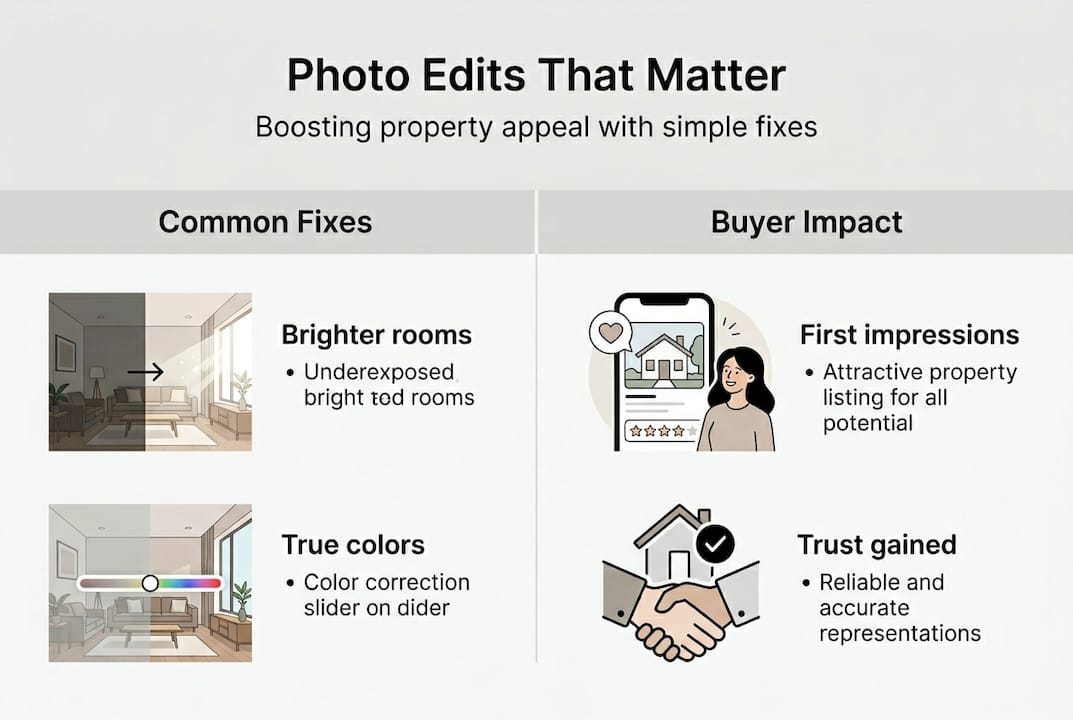
A before-and-after comparison is worth more than any description. Take a living room with a single overhead light source. Before editing, the photo looks flat, the couch color is off, and the window is a white glare. After editing, the exposure is balanced, the couch reads as the warm gray it actually is, and the window shows a clear sky beyond. Same room. Completely different emotional response.
Pro Tip: Use a stunning interior photo tutorial to walk through these corrections step by step, even if you’re not a professional photographer. Most of these fixes are learnable in an afternoon.
Risks of over-editing: Balancing appeal with authenticity
Editing offers amazing benefits, but applying the right amount is critical. Here’s where professionals walk the line.
Over-editing is a real problem in real estate photography. When you push enhancements too far, you create a gap between what buyers see online and what they experience in person. That gap destroys trust. Over-editing risks creating unrealistic expectations and can breach disclosure requirements depending on what was changed.
The National Association of Realtors (NAR) has clear guidance here. Virtual enhancements, AI-generated changes, and any modifications that alter the actual features of a property must be disclosed to buyers. This includes things like digitally adding a pool, removing a power line that’s actually there, or making a small yard look expansive.
| Edit type | Ethical and effective | Problematic and risky |
|---|---|---|
| Brightness adjustment | Corrects camera limitations | Hiding water damage or dark stains |
| Sky replacement | Replaces an overcast sky | Making a north-facing home look south-facing |
| Virtual staging | Furnishes an empty room | Adding features the property doesn’t have |
| Color correction | Accurate color representation | Changing wall colors without disclosure |
The seamless photo editing guide approach focuses on corrections that reflect reality more accurately, not ones that fabricate it. Think of editing as cleaning a window rather than painting a new view.
For agents using AI photo editing for real estate, the same ethical standard applies. AI tools that change wall colors, remove furniture, or alter lighting should be used to help buyers visualize possibilities, not to misrepresent the property’s current condition.
Pro Tip: Always include a note in your listing description when virtual staging or AI enhancements have been used. It protects you legally and builds buyer trust before the first showing.
Subtle edits that correct camera limitations are universally accepted and expected. Edits that change what a property actually looks like cross into misleading territory. The line is clearer than most people think.
Fast enhancements for busy professionals: Tools and workflows
If you’re ready to amplify your own photos, here are fast, effective paths for every skill level.
Time is the biggest obstacle for real estate agents and designers who want better photos. You don’t have hours to spend in Photoshop between listings. The good news is that modern tools have compressed what used to take hours into minutes, and in some cases, seconds.
Here’s a practical workflow for consistent, fast results:
- Shoot in RAW format if your camera allows it. RAW files hold more data and respond better to editing corrections than JPEGs.
- Batch edit using presets in tools like Lightroom. One preset applied across 20 photos creates instant consistency.
- Use AI-powered platforms for specific tasks like object removal, sky replacement, or virtual staging. These tools handle complex edits automatically.
- Review on multiple screens before publishing. A photo that looks great on your laptop may appear too dark on a mobile device.
- Create a quality checklist that covers exposure, white balance, perspective, and clutter for every image before it goes live.
Outsourcing can deliver quality and speed but may risk inconsistency if the provider is not chosen carefully. If you outsource, always request sample edits first and provide a clear style guide.
For those who prefer to handle edits themselves, efficient AI photo editing platforms have made it possible to describe the change you want in plain language and receive a polished result almost instantly. No technical expertise required.
Pro Tip: If you’re new to editing, start with the edit interior photos quickly approach: fix exposure first, then white balance, then perspective. These three corrections alone will dramatically improve most property photos.
Speed and quality are no longer mutually exclusive. The right workflow means you can move fast without sacrificing the professional standard your clients expect.
What most photo editing guides miss—and how to truly stand out
Most editing guides focus entirely on style. Warmer tones, brighter whites, more dramatic skies. Style advice is useful, but it misses the bigger picture.
What actually separates effective property photo editing from noise is authenticity combined with speed. Buyers and renters in 2026 are more visually sophisticated than ever. They’ve seen enough over-edited listing photos to recognize when something looks too polished to be real. When that happens, skepticism replaces excitement.
The agents and designers who consistently win are not the ones with the most dramatic edits. They’re the ones whose photos feel trustworthy and look great at the same time. That combination is harder to achieve than pure style, but it’s far more valuable.
Workflow simplicity matters too. Complicated editing processes create bottlenecks that slow down listings and frustrate clients. A DIY photo editing guide built around simple, repeatable steps will outperform a complex, inconsistent process every time. Speed and transparency together create a competitive edge that style alone never will.
Get professional photo results in minutes with VibeMyFlat
Everything covered in this guide points to one practical reality: great property photos require the right tools and a fast, reliable process.

VibeMyFlat is built exactly for this. You describe the change you want in plain language, and the AI handles the rest in under 30 seconds. No complex software, no steep learning curve, no waiting on outsourced providers. Whether you need to adjust lighting, update wall colors, or visualize a redesigned space, VibeMyFlat delivers professional-quality results that feel authentic and are ready to publish. Explore user-friendly apartment editing features designed specifically for agents, designers, and homeowners who need results fast without compromising on quality.
Frequently asked questions
What are the biggest mistakes in real estate photo editing?
The biggest mistakes are over-editing, which makes photos look unrealistic, and failing to disclose virtual enhancements as required by NAR policy. Both erode buyer trust before the first showing.
How does professional editing increase property value?
Professional editing showcases a property’s best features clearly, which drives more interest and often leads to higher sale prices. More compelling photos mean more competing buyers.
Is there a risk in using fast or outsourced photo editing?
Yes. Outsourcing can create inconsistency in quality if the provider doesn’t understand your style or standards. Always vet providers with sample edits before committing.
What photo edits require disclosure to buyers or renters?
AI-driven enhancements, virtual staging, and any changes to actual property features must be disclosed, as required by NAR guidelines. This protects both the agent and the buyer.