What is natural language photo editing: AI guide for 2026
What is natural language photo editing: AI guide for 2026
Most people believe photo editing demands mastery of complex software like Photoshop with layers, masks, and countless tools. Natural language photo editing changes everything by letting you modify images through simple text commands like “add a modern sofa” or “brighten the room.” This AI-driven approach eliminates technical barriers, offering real estate professionals, interior designers, and homeowners an efficient way to visualize interior spaces without specialized training. Understanding how this technology works and its practical applications can transform your workflow and client presentations.
Table of Contents
- Key takeaways
- Understanding natural language photo editing technology
- Limitations and expert nuances of natural language photo editing
- Comparing natural language photo editing methods and benchmarks
- Using natural language photo editing for interior design and real estate visualization
- Explore VibeMyFlat for your AI photo editing needs
- Frequently asked questions
Key Takeaways
| Point | Details |
|---|---|
| Text based editing | Natural language prompts let you modify images without learning complex software. |
| Maskless edits | Conditional diffusion models edit images by following instructions while preserving unedited areas. |
| Limitations persist | Complex multi object changes and identity preservation remain challenging compared with proprietary models. |
| Single object prompts | Starting with simple one item edits helps you learn effective prompts before tackling more complex changes. |
Understanding natural language photo editing technology
Natural language photo editing represents a breakthrough in how we interact with image modification tools. Instead of navigating complex interfaces, you describe changes in plain language. InstructPix2Pix using diffusion models demonstrates this approach where users edit images through free-form text instructions like “add a sofa” or “change lighting to golden hour” without masks or detailed prompts. The technology democratizes professional-level editing for anyone who can describe their vision.
The underlying mechanism relies on sophisticated AI architecture. Conditional diffusion models using Stable Diffusion take an input image and instruction, encode both, then denoise to produce an edited image while preserving unmentioned areas. This process happens automatically, eliminating the need for manual selection tools or layer management. The model learns from millions of image-text pairs to understand spatial relationships, object properties, and design principles.
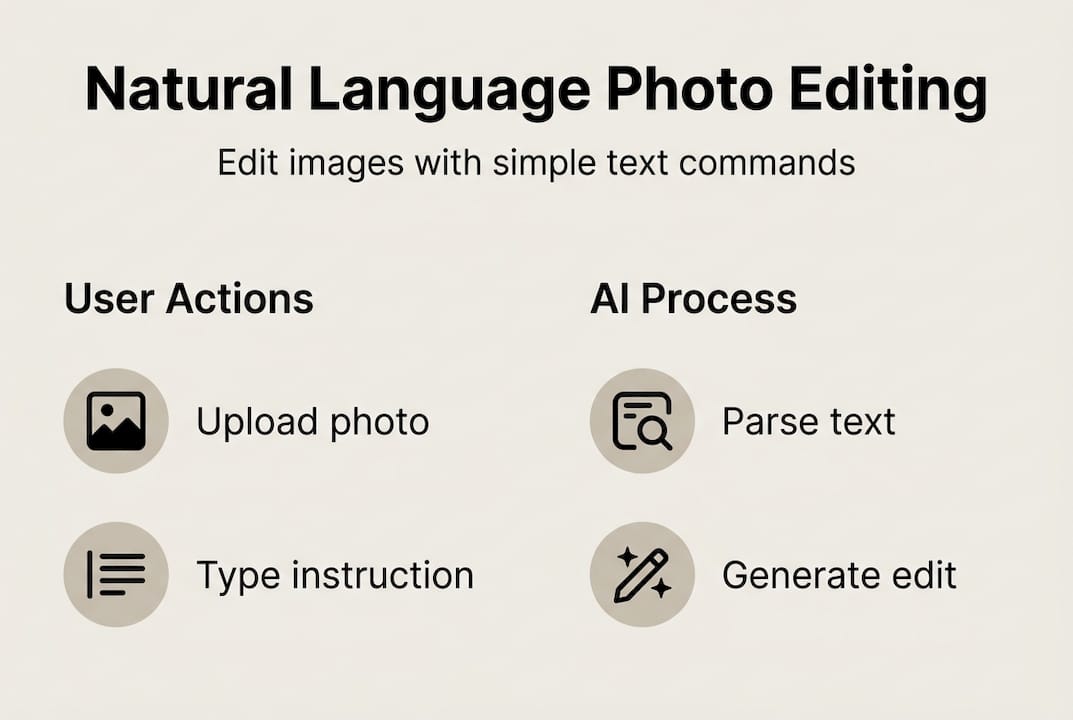
The workflow is remarkably straightforward for end users. You upload a photo of an interior space, type your desired modification, and receive results within seconds. The AI interprets context, identifies relevant objects, and applies changes while maintaining visual consistency. Unedited portions remain intact, preserving the original photo quality and composition. This selective editing capability makes the technology particularly valuable for real estate and design professionals who need quick iterations.

Pro Tip: Start with single-object edits to understand how the AI interprets your commands before attempting complex multi-element changes. This builds intuition for effective prompt crafting.
Platforms like VibeMyFlat AI photo editor implement these models to deliver professional results without requiring technical expertise. The technology continues advancing rapidly, with newer models showing improved understanding of spatial relationships and design aesthetics. For interior visualization, this means faster concept development and more efficient client communication compared to traditional editing workflows.
Limitations and expert nuances of natural language photo editing
Despite impressive capabilities, current natural language photo editing faces significant challenges in professional applications. Complex multi-object instructions, identity preservation, multi-turn edits, and logical reasoning present difficulties, with open-source models underperforming proprietary ones. Understanding these limitations helps set realistic expectations and develop effective workarounds for real-world projects.
Common failure modes include over-editing where the AI modifies unintended image areas or under-editing where changes appear too subtle. Identity preservation proves particularly tricky when replacing objects. Ask the system to swap a leather couch for fabric, and you might get a completely different furniture style rather than the same design in new material. Multi-turn editing compounds errors, as each successive modification can introduce artifacts or inconsistencies that accumulate over multiple iterations.
“The gap between open-source and proprietary models remains substantial, with closed-source solutions demonstrating superior instruction following and maintaining better image coherence across complex edits.”
Logical reasoning presents another hurdle. Commands requiring spatial understanding like “move the lamp to the left of the window” often confuse current systems. The AI might relocate the lamp but place it awkwardly or fail to adjust shadows and reflections accordingly. Physical plausibility suffers when edits violate real-world constraints, such as furniture floating or lighting that contradicts the scene’s geometry. These issues become critical in professional contexts where clients expect photorealistic results.
For interior design and real estate applications, balancing automation with manual input becomes essential. Pure AI edits work well for simple color changes or adding single objects. Complex renovations or precise staging require hybrid approaches combining natural language instructions with traditional editing techniques. Professionals using VibeMyFlat AI photo editor often generate initial concepts through text commands, then refine details manually to achieve the polish clients expect. This workflow leverages AI speed while maintaining human control over critical aesthetic decisions.
Comparing natural language photo editing methods and benchmarks
Evaluating natural language photo editing systems requires understanding performance metrics and benchmark datasets. Benchmarks like HQ-Edit and Complex-Edit show open-source models lag behind closed-source solutions in instruction following and image coherence. These standardized tests reveal significant performance gaps that impact practical applications for professionals.
Major benchmarks assess different capability dimensions. HQ-Edit focuses on instruction adherence and visual quality for single edits. Complex-Edit tests multi-object modifications and logical reasoning. RISEBench evaluates real-world scenarios including interior design tasks. Metrics include CLIP similarity scores measuring how well results match text descriptions, human preference ratings, and technical measures like image fidelity and artifact presence. Together, these benchmarks provide comprehensive performance profiles.
| Model | Instruction Following | Image Quality | Complex Edit Score | Best Use Case |
|---|---|---|---|---|
| Seedream 4.0 | 94% | Excellent | 87/100 | Professional real estate staging |
| InstructPix2Pix | 78% | Good | 71/100 | Quick concept visualization |
| Open-source average | 65% | Fair | 58/100 | Experimental projects |
| Proprietary average | 89% | Excellent | 82/100 | Client-facing deliverables |
Training data quality dramatically impacts results. InstructPix2Pix improves performance 12.3% using HQ-Edit dataset showing the impact of training data. Models trained on curated, high-quality image-instruction pairs outperform those using web-scraped data. Architecture choices matter too, with transformer-based encoders and multi-scale diffusion processes yielding better spatial understanding than simpler approaches.
Pro Tip: When selecting AI editing tools for professional work, prioritize platforms using proprietary or fine-tuned models over generic open-source implementations. The performance difference justifies investment for client projects.
For real estate and interior design professionals, these benchmarks guide tool selection. High-stakes applications like luxury property marketing demand top-tier models with excellent instruction following. Preliminary concept development or personal projects can use more accessible options. VibeMyFlat interior design tools balance accessibility with professional-grade results, making advanced editing capabilities available without enterprise-level costs. Understanding benchmark performance helps match technology capabilities to project requirements effectively.
Using natural language photo editing for interior design and real estate visualization
Practical application of natural language photo editing transforms how professionals approach interior visualization and property marketing. The technology accelerates redesign concept development, enables rapid client iteration, and reduces costs compared to traditional rendering or physical staging. Hybrid approaches combining manual masks with natural language instructions improve precision for interior design tasks, delivering results that meet professional standards.
Successful implementation follows structured workflows optimized for AI capabilities:
- Start with high-quality source photos showing clear room layouts and good lighting conditions for best AI interpretation
- Use specific, single-action commands like “replace the blue sofa with a gray sectional” rather than complex multi-step instructions
- Build edits sequentially, verifying each change before proceeding to maintain image consistency and quality
- Combine AI-generated elements with manual refinements for shadows, reflections, and fine details that ensure photorealism
- Create multiple variations quickly to present diverse options during client meetings or listing presentations
Common interior editing applications include furniture placement and replacement, wall color modifications, lighting adjustments from natural to artificial sources, flooring material changes, and decor additions like artwork or plants. Real estate professionals use these capabilities to stage empty properties virtually, update dated interiors for listings, and show renovation potential to buyers. Interior designers leverage the technology for rapid concept exploration, helping clients visualize options before committing to purchases or contractors.
The speed advantage proves transformative. Traditional rendering might require hours or days per image. Natural language editing delivers initial results in seconds, allowing dozens of variations in the time conventional methods produce one. This velocity enables more creative exploration and better client collaboration. You can adjust designs in real time during meetings, incorporating feedback immediately rather than scheduling follow-up presentations. For homey personalized decor tips, quick visualization helps homeowners experiment with different styles before making purchases.
Integrating AI edits into professional workflows requires balancing automation with quality control. Generate base edits through VibeMyFlat photo editing app, then enhance with traditional tools for final polish. This hybrid approach captures AI efficiency while maintaining the craftsmanship clients expect. Document successful prompts to build a personal library of effective commands for recurring tasks. Over time, you develop intuition for which edits work well automatically versus which need manual intervention, optimizing your workflow for maximum productivity.
Explore VibeMyFlat for your AI photo editing needs
Ready to experience natural language photo editing firsthand? VibeMyFlat brings professional AI editing capabilities directly to real estate agents, interior designers, and homeowners without requiring technical expertise or expensive software subscriptions. The platform combines cutting-edge diffusion models with an intuitive interface designed specifically for interior visualization and property marketing applications.
VibeMyFlat processes edits in under 30 seconds, letting you generate multiple design variations during client meetings or property showings. The AI understands interior design principles, ensuring furniture placement looks natural and lighting changes maintain realistic shadows and reflections. Whether you need to stage an empty apartment, update a dated kitchen, or show renovation potential, the platform handles common real estate and design tasks with professional-quality results. The mobile apps for iOS and Android mean you can edit photos on-site during property visits or client consultations.
The VibeMyFlat AI photo editor supports multi-turn editing, allowing you to refine results through follow-up commands without starting over. This iterative approach mirrors natural design processes where you adjust elements until achieving the perfect look. The platform also provides templates and prompt suggestions based on common interior design scenarios, helping new users craft effective commands quickly. For professionals managing multiple projects, batch processing capabilities streamline workflow when updating entire property portfolios or creating seasonal listing variations.
Pro Tip: Use VibeMyFlat-generated edits as conversation starters in client presentations, then refine the most promising options with additional detail to demonstrate design possibilities efficiently.
Explore VibeMyFlat interior design tools to discover how natural language photo editing can accelerate your visualization workflow and enhance client communication. The platform offers flexible pricing for individual professionals and teams, making advanced AI editing accessible regardless of business size. Start transforming your interior photos today and experience the efficiency gains that natural language editing delivers for modern real estate and design professionals.
Frequently asked questions
What is natural language photo editing?
Natural language photo editing is an AI-powered technique that modifies images through simple text commands rather than manual tool manipulation. You describe desired changes in everyday language like “brighten the room” or “add a coffee table,” and the AI applies those modifications automatically. This approach eliminates the learning curve associated with traditional photo editing software, making professional-quality results accessible to anyone who can articulate their vision clearly.
How does natural language photo editing work technically?
The technology uses conditional diffusion models that process both your input image and text instruction simultaneously. These AI systems encode the visual content and language command, then generate an edited version through a denoising process that preserves unmentioned image areas. The models learn from millions of image-text pairs during training, developing understanding of objects, spatial relationships, and aesthetic principles. No manual masking or image-specific retraining is required, making the editing process fast and accessible.
What are common limitations of natural language photo editing?
Current systems struggle with complex multi-object instructions, maintaining object identity across edits, and sequential modifications that accumulate errors. The AI may over-edit by changing unintended areas or under-edit by applying changes too subtly. Logical reasoning about spatial relationships often fails, resulting in physically implausible arrangements. Open-source models particularly underperform compared to proprietary solutions in instruction following and image coherence, making tool selection critical for professional applications.
How can interior designers and real estate professionals best use this technology?
Use stepwise commands that modify one element at a time rather than complex multi-part instructions for better results. Combine AI-generated edits with manual refinements to achieve the precision and polish clients expect in professional deliverables. Leverage the technology’s speed to create multiple design variations quickly, enhancing client presentations and enabling real-time collaboration during meetings. Build a library of effective prompts for recurring tasks to optimize your workflow efficiency over time.
Is natural language photo editing suitable for professional real estate marketing?
Yes, when used strategically as part of a hybrid workflow that combines AI efficiency with human quality control. The technology excels at rapid concept generation, virtual staging, and creating multiple listing variations quickly. However, high-stakes applications like luxury property marketing may require manual refinement of AI-generated edits to ensure photorealistic quality and brand consistency. Platforms designed specifically for real estate and interior design applications deliver better results than generic AI editing tools for professional use cases.